Many families seek governance support only after tensions have surfaced. By then, conversations can feel heavy and reactive.
The most resilient family enterprises take a different approach. They design governance early so expectations are clear, roles are understood, and relationships stay strong as the business grows.
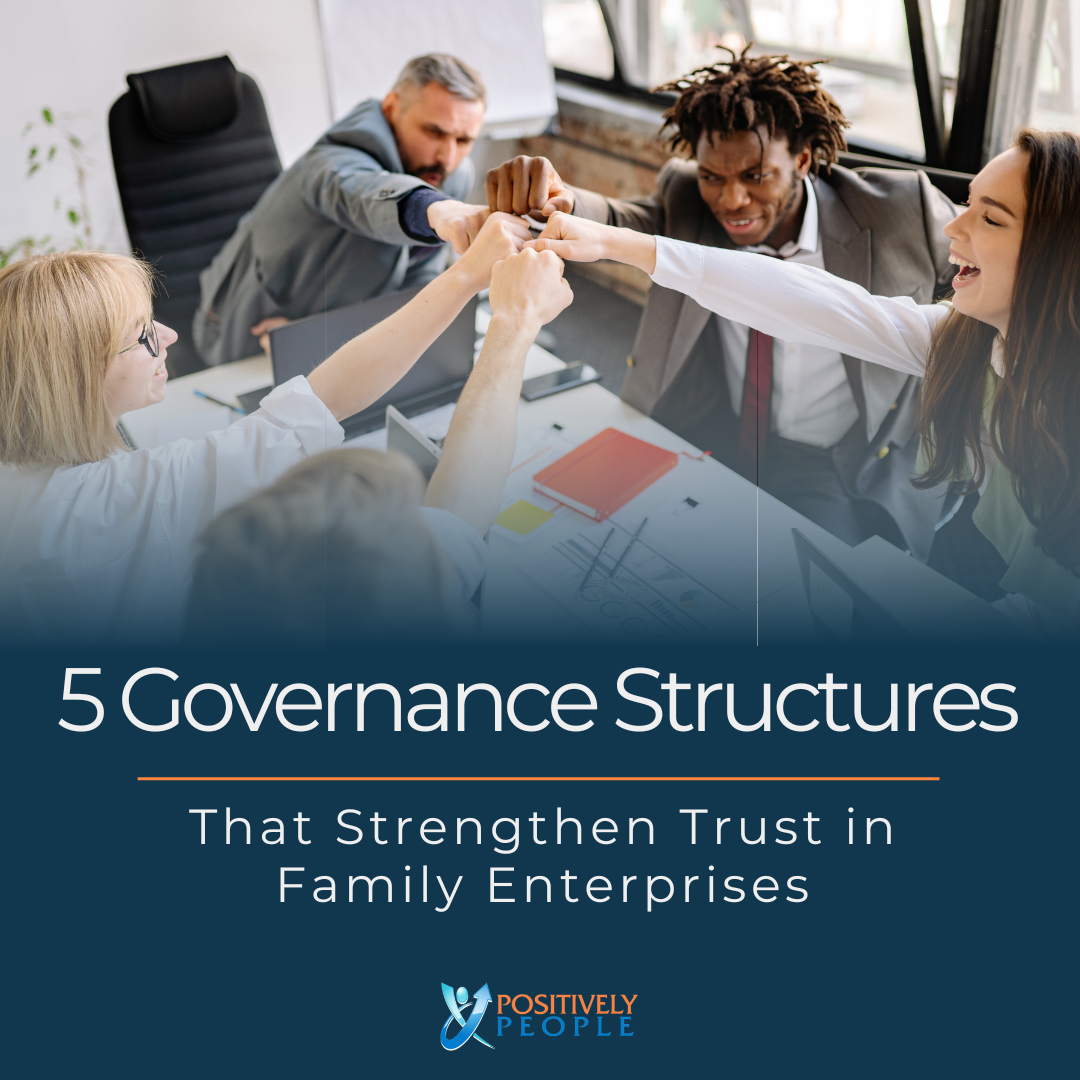
In our earlier article Building Stronger Family Bonds Through Governance, we explored governance as a relationship-building tool. Here, we highlight five practical structures that help families create clarity, alignment, and long-term trust.
When governance is thoughtfully designed, it protects both business performance and family relationships.
1. A Clear Owner Strategy Document
Strong family enterprises begin with a shared understanding of ownership.
An owner strategy document helps families clarify the purpose behind owning the enterprise together and how that ownership will function over time.
It typically answers questions such as:
- Why are we choosing to own this enterprise together?
- What types of returns matter most to us — financial growth, income, legacy impact, or community influence?
- How and when will owners receive distributions or liquidity?
When these expectations are discussed openly, families avoid misunderstandings and can make decisions with greater confidence.
Different perspectives are normal. One generation may prioritize reinvestment, while another values stable income. A written owner strategy does not eliminate those differences, but it gives the family a shared language for navigating them productively.
2. Transparent Criteria for Leadership and Board Roles
Clarity around leadership roles builds credibility across generations.
When families define and communicate the criteria for leadership and governance positions, decisions become easier to understand and support.
Consider documenting criteria for:
- Executive roles, including required experience, leadership capabilities, and behavioral expectations
- Board seats, including independent versus family representation and term expectations
- Advisory roles for family members who are not active in day-to-day management
When expectations are visible and consistent, leadership decisions feel grounded in merit and preparation rather than personal preference.
This approach aligns with the principles explored in Ensuring the Family Business Culture and Values Are Upheld, where governance structures reinforce the values the family wants to carry forward.
3. A Functioning Family Council
A well-designed family council provides a dedicated space for family-level conversations.
Rather than allowing questions about ownership, dividends, or next-generation involvement to surface informally, the family council offers a structured forum for discussion and alignment.
For example, one enterprise we worked with noticed growing questions about dividend policies. Instead of letting those concerns circulate through informal conversations, the family council created a space to clarify reinvestment priorities, distribution philosophy, and communication expectations.
The outcome was not perfect agreement, but it was shared understanding and stronger alignment.
A functioning family council keeps family conversations where they belong and allows the leadership team to focus on running the business.
4. A Simple Conflict Resolution Path
Healthy enterprises do not avoid disagreement. They create clear ways to navigate it.
A simple conflict resolution pathway can help family members address issues constructively before they escalate.
Drawing on insights from articles such as:
- The Silent Growth Killer: Unspoken Conflict in Family Enterprises
- Communication Strategies to Resolve and Prevent Family Business Conflict
- How to Handle Family Business Conflict
families can define a simple process such as:
- Direct one-on-one conversation
- Structured facilitated conversation if needed
- Family council discussion
- Board involvement when appropriate
When everyone understands how concerns are addressed, people feel safer raising issues early. Structure supports thoughtful conversation and reduces unnecessary tension.
5. Regular Governance Health Checks
Governance works best when it evolves with the enterprise.
Families grow, ownership structures expand, and leadership responsibilities shift over time. Governance structures that worked five years ago may need adjustment today.
Many families find it helpful to conduct an annual governance review by asking:
- Are decision rights still clear?
- Is the board functioning effectively?
- Is the family council productive?
- Are conflict norms being used constructively?
- Are pathways for the rising generation clearly defined?
This practice complements the thinking in Measuring the Effectiveness of Your Continuity Plan, which emphasizes revisiting structures regularly to ensure they support real-world needs.
Governance that is reviewed and refined stays relevant and effective.
Governance as a Foundation for Long-Term Success
The families who sustain successful enterprises across generations rarely leave governance to chance.
They take time to clarify expectations, design decision-making structures, and create space for honest conversation.
They recognize that governance is not simply a legal framework. It is a shared system that helps families lead together, adapt through change, and steward the enterprise responsibly.
When governance is intentional, it strengthens both the business and the relationships that make the enterprise possible.