As Chair of the Systems Thinking Global Virtual Study Group for the Family Firm Institute (FFI), I have the privilege of facilitating monthly discussions with family business advisors, researchers, and academics from around the world. Our sessions challenge conventional thinking, encourage diverse perspectives, and explore the issues shaping the future of family enterprises.
This month, our discussion focused on Artificial Intelligence (AI) and its implications for family businesses. While the session began with a presentation on the role of AI in family business boards vs non family business boards, it quickly evolved into a broader conversation about governance, risk, and the future of advising family enterprises.
Several important themes emerged.
AI is no longer optional.
We agreed that AI is not a passing trend—it is becoming a permanent part of how organizations operate, compete, and innovate. The question for family enterprises is no longer whether AI will impact their business, but how intentionally they will respond.
The role of the family business advisor is changing.
As advisors, our responsibility is not to become AI experts or technology consultants. Rather, we help families navigate uncertainty with confidence, ask better questions, and develop thoughtful governance practices that support sound decision-making.
Our work is helping families embrace innovation without losing sight of their values, relationships, and long-term vision.
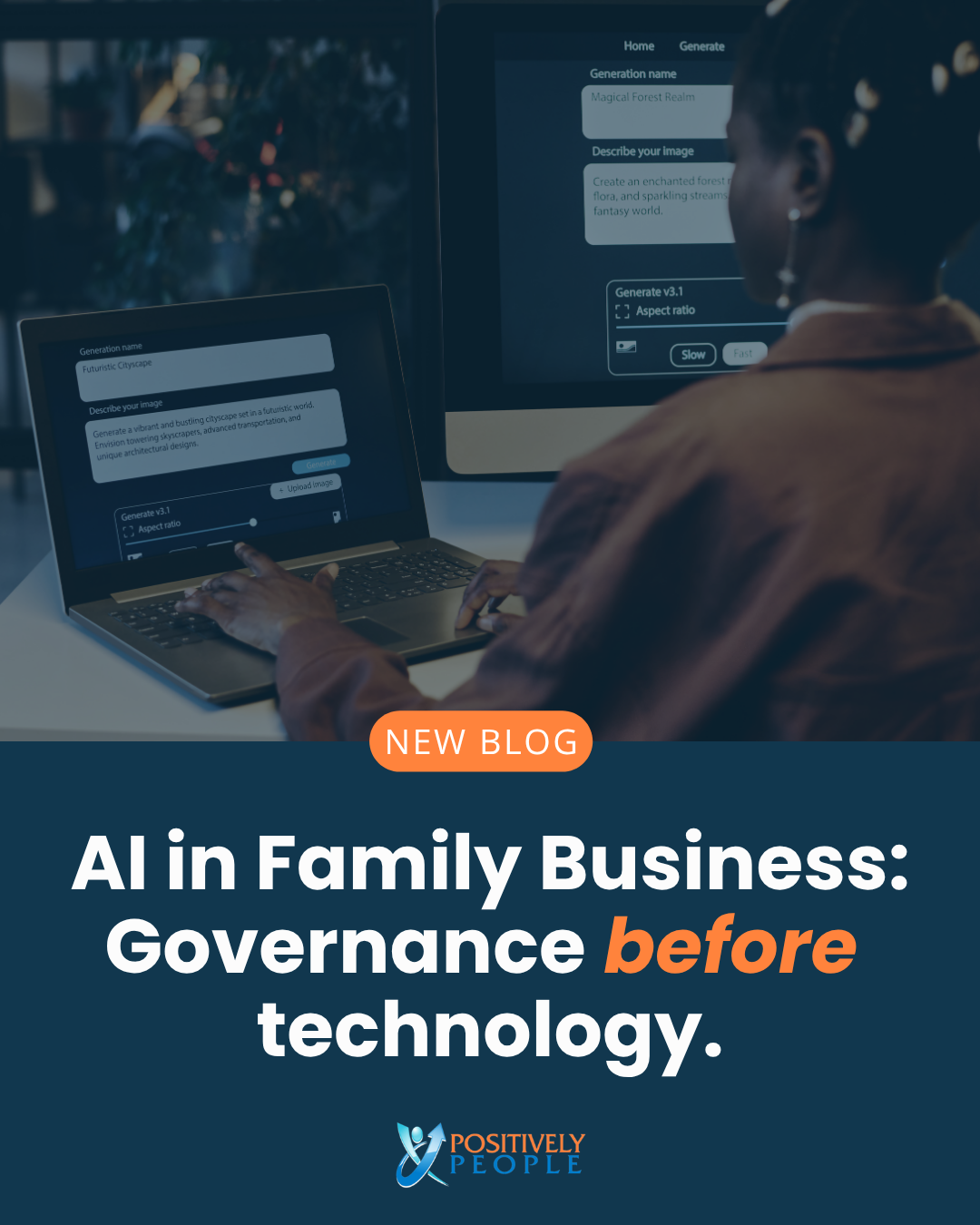
Strategy should follow governance.
One of the strongest insights from our discussion was that many organizations are rushing to adopt AI without first establishing the governance needed to guide its use.
Before creating an AI strategy, family businesses should address creating a governance framework that supports AI.
- Why AI is being adopted and how it supports the family’s vision and business strategy.
- Expectations for ethical and responsible use.
- Policies and standards that guide employees and leadership.
- Risk management, privacy, security, and compliance considerations.
- Processes for oversight, monitoring, and continuous improvement.
Without governance, AI adoption can become fragmented across the organization, increasing risk, creating inconsistent practices, and causing businesses to miss opportunities for competitive advantage.
My takeaway
For family enterprises, AI is ultimately a leadership and governance conversation—not simply an IT conversation.
The family enterprises that will benefit most from AI will be those that approach it intentionally, establishing clear governance before widespread implementation. By aligning AI with their values, long-term vision, and governance practices, family businesses can embrace innovation while preserving the trust, stewardship, and continuity that define successful multigenerational enterprises.